
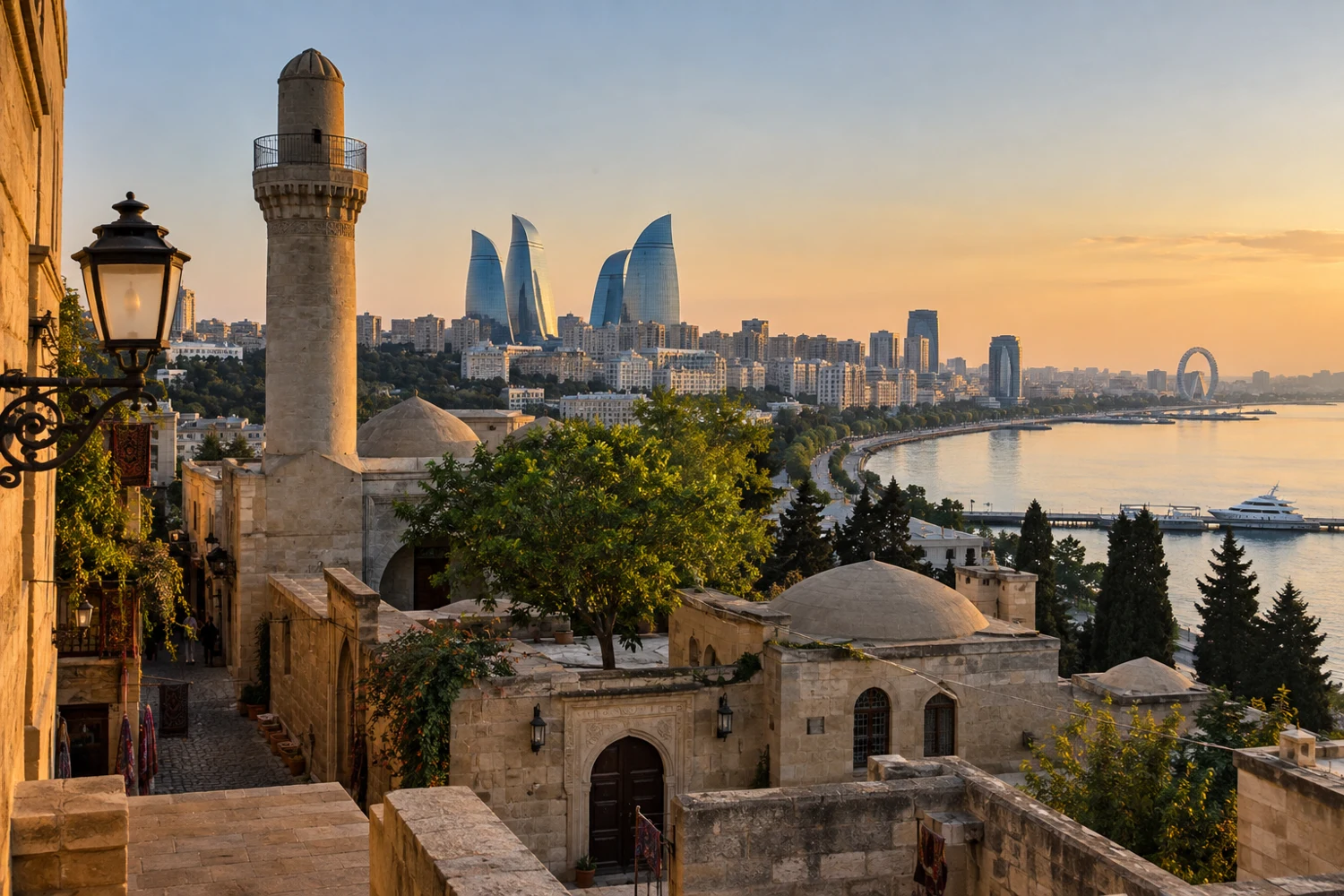
A place with more than one story
UNESCO’s World Heritage listing brings together Baku’s Walled City, the Shirvanshahs’ Palace and the Maiden Tower. The site stands on the Absheron Peninsula beside the Caspian Sea. Its surviving buildings and archaeological evidence reflect successive cultural influences rather than one single moment in time.
The Inner City, also called Icherisheher, retains much of its medieval defensive wall. The palace complex occupies a high point within the historic city. UNESCO notes uncertainty about aspects of the Maiden Tower’s earliest history: it should not be reduced to a confident claim about one original purpose.
For the historical account, plans and conservation information, read the UNESCO World Heritage entry.
How to explore the subject
Begin with a map rather than a checklist of famous buildings. Find the walls, then the tower and palace. Ask what changes when you consider streets and homes between the monuments as part of the story too.
When reading about an old building, separate what survives, what researchers infer and what belongs to legend. A story can be meaningful without being a proven explanation of a monument. Keeping those categories clear makes a family discussion more interesting, not less.
A conversation across generations
For a family in Britain, a photograph of Baku can start a conversation about place names, journeys and everyday memories. Ask someone who knows the city what they remember doing there. Compare that personal account with the heritage description: they answer different questions.
Children might choose one detail to draw or one unfamiliar name to learn. There is no need to turn the conversation into a history test. The aim is to build curiosity and give each person room to ask their own questions.
Read next
Continue with Sheki’s historic centre for another way to think about buildings and community life. To meet people sharing these interests in Britain, explore BAA events.