
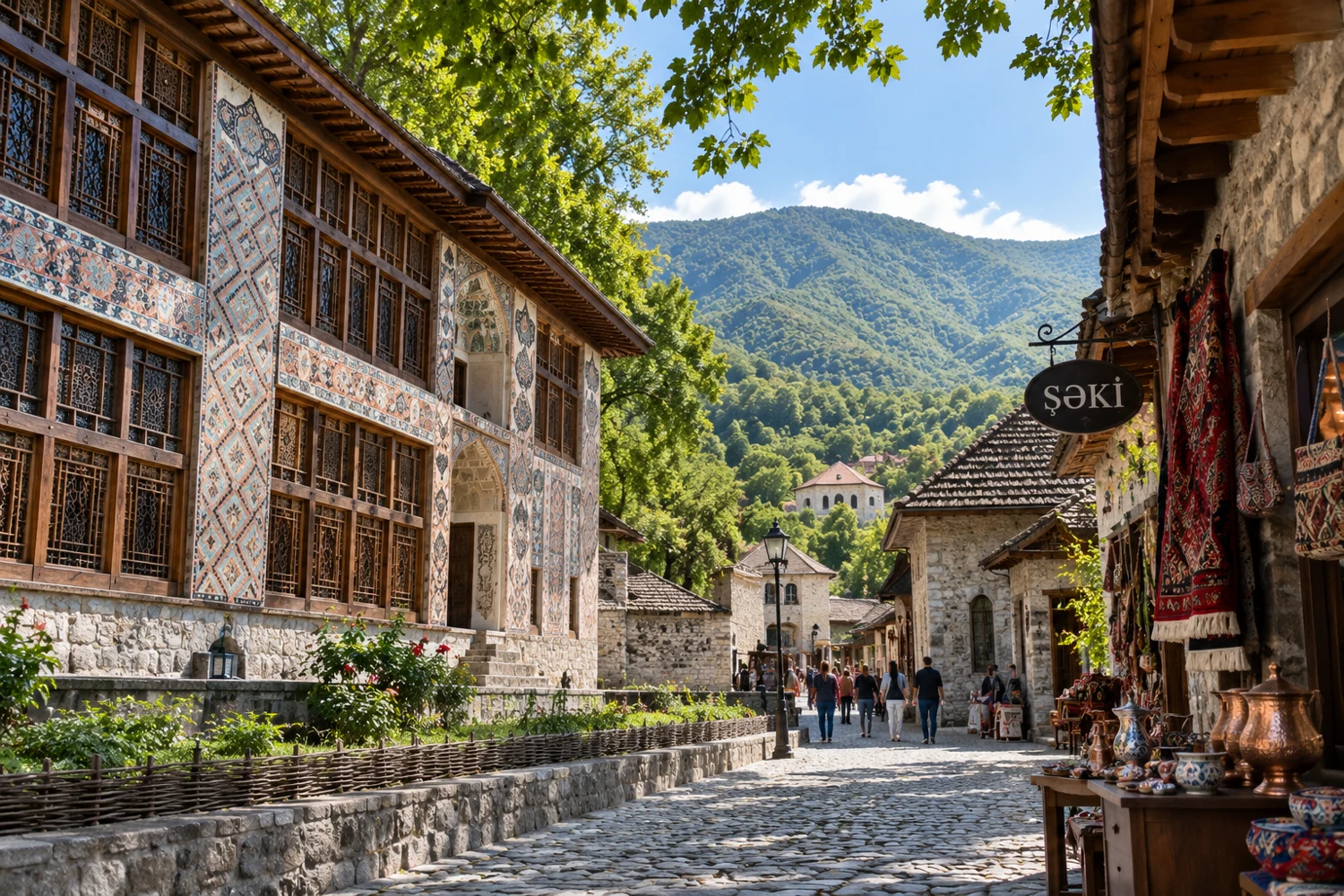
The palace belongs to a wider town
UNESCO lists the Historic Centre of Sheki with the Khan’s Palace as a World Heritage property. Its description connects the town’s architecture with trade routes and the prosperity of silk production. Merchants’ houses and other historic buildings help explain why the palace should be understood within its urban setting.
The palace’s decorative surfaces and windows reward close attention, but the surrounding streets are part of the heritage too. UNESCO’s account describes a town shaped by exchanges between different building traditions and by its position in a mountain landscape.
Read the UNESCO description and conservation record for the documented history.
Looking closely at craft
A useful way to approach decorative architecture is to pick one detail and ask how it was made. What material do you see? Where does a pattern repeat? How does daylight change what you notice? These questions work with a good photograph as well as during a visit.
Try comparing a whole-building view with a close-up. The first explains scale and setting; the second reveals choices that are easy to miss. Neither image on its own tells the whole story of the building or the people who made it.
Sharing heritage at home
For families in Britain, looking at a pattern together can be a practical introduction to a place they know mainly by name. Children can sketch the shapes they notice, while adults share memories or questions. An activity does not have to reproduce an expert craft to lead to a worthwhile conversation.
Where a family has a personal connection to Sheki, distinguish that memory from a general claim about the town. Personal stories bring a subject to life; documentary sources help put them in context.
Continue exploring
Compare Sheki with Baku’s Old City, or explore tea and hospitality as a different form of living heritage. BAA welcomes ideas for sourced cultural contributions through our contact page.